Minecraft Dungeons II is a hack-and-slash dungeon crawler: up to four players carve through mobs, collect armor, weapons and artifacts, and push a story about saving two worlds. What changed from the first game is how much of that loop you control. Mojang's own framing on the Minecraft Live stream: the first game was a linear chain of missions, and this one is a connected world you move through and explore on your own terms.
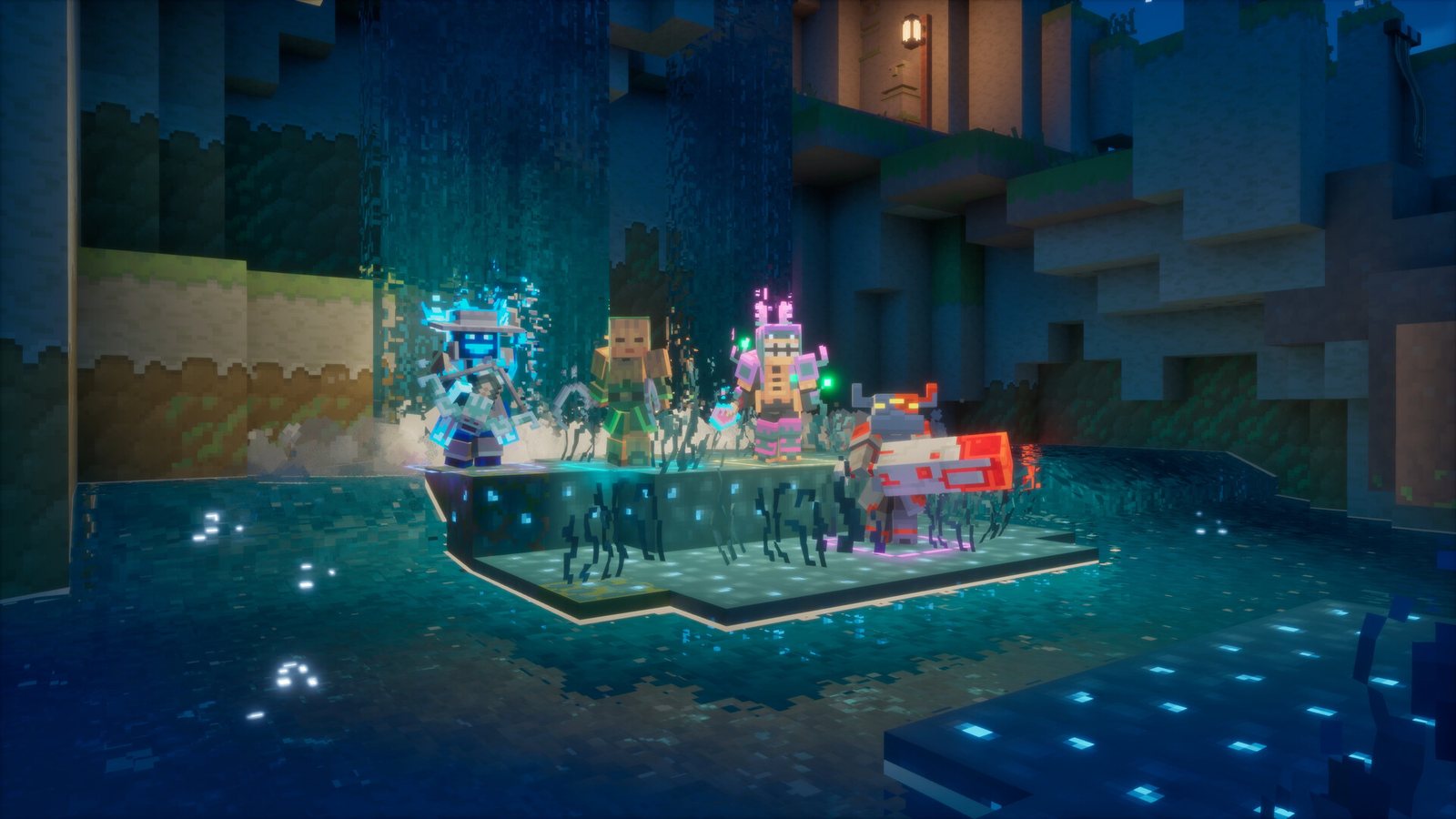
The interconnected world
Mojang is precise here, and the distinction matters for expectations: the developers call Dungeons II an interconnected world, not an open world. Large regions connect into one traversable map with settlements, narrative events, ancient structures, hubs and points of interest, and you choose your route through them. Guidance still exists, so it is not a boundless sandbox. Caves and ruins can reshuffle their layouts between runs, which keeps revisits from feeling like replays.
⚠️ Terminology. Any page calling this an open world is using a shortcut. The developers' own wording, on the record, is "interconnected", with explicit guidance steering the route.
Movement: the jump changes everything
The single most requested feature from the first game is here. Jumping adds vertical routes, small parkour pockets with hidden secrets, and the jump attack: a heavy area strike from above that hits groups hard but leaves you exposed while recovering. The dodge roll from the first game returns alongside it.
Equipment: more slots, more decisions
| System | First game | Dungeons II |
|---|---|---|
| Combat slots | 6 | 12 |
| Armor | One piece | Four: helmet, chestplate, leggings, boots |
| Passive items | Artifacts | Artifacts plus new talismans |
| Ranged ammo | Finite arrows | Unlimited, regenerates over time |
Twelve combat slots and four armor pieces mean a build is spread across many more decisions: how talismans, artifacts and the blacksmith interact. Ranged weapons no longer run dry mid-fight; arrows replenish themselves over time, so a bow build keeps firing without scavenging.
Loot and progression
Dropped gear can roll random bonus effects, so two copies of the same item can behave differently, and it is worth reading drops instead of auto-deleting duplicates. When a roll disappoints, the town blacksmith can reroll special effects using echo shards. Characters level up, enchantment points accumulate, and enchantments can be upgraded to level 3. The full enchanting system.
Quests and structure
Quests split into main quests, which push the story of the soul corruption and the Illager High Council, and side quests, which send you after missing bees, lost creatures and village problems. The town of Brave Haven replaces the first game's camp as your base between runs. Inside Brave Haven.
FAQ
Is there a class system?
No fixed classes. Build identity comes from gear, talismans and artifacts, so a mage, a summoner or a melee brawler is a loadout choice you can change between runs.
How many players can play together?
Up to four, online or on a couch, with crossplay between platforms. Multiplayer details.
Is the game harder than the first one?
The developers presented the Monarch boss fight as genuinely difficult during the launch stream, and the deeper build systems imply harder tuning, but no official difficulty-tier list has been published.